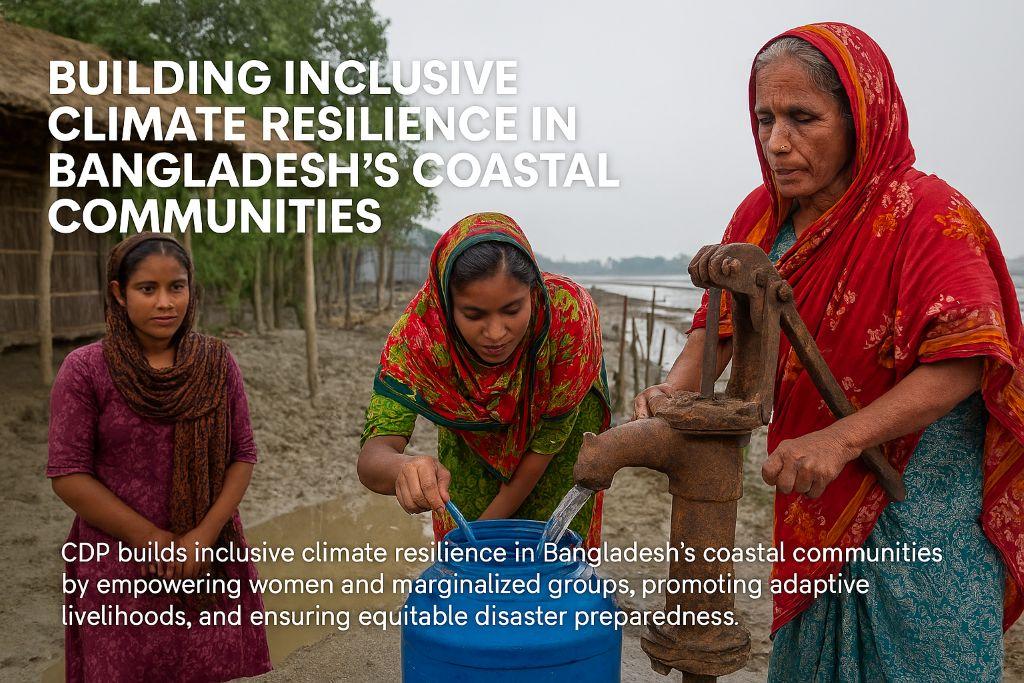
Building Inclusive
Climate Resilience in Bangladesh’s Coastal Communities
In Bangladesh’s coastal belt, climate
change is not a future risk—it is a lived reality. Communities face recurring
cyclones, flooding, salinity intrusion, and river erosion that disrupt
livelihoods, damage homes, and strain essential services year after year. For
families living on the frontline, climate-related disasters are no longer
isolated emergencies but continuous pressures shaping everyday survival and
long-term decisions. However, not everyone is affected equally by climatic
threats. Social roles, resource availability, and decision-making participation
all influence risk exposure, readiness, and recuperation. Women, teenagers,
people with disabilities, the elderly, and households with low incomes
frequently experience a disproportionate share of the effects of climate change
while having the fewest opportunities to influence solutions. At Coastal
Development Partnership (CDP), we recognize that effective disaster risk
reduction and climate adaptation must reflect these intersectional realities.
Building inclusive resilience is not only a matter of equity—it is essential
for achieving sustainable and lasting impact.
Climate Risk Seen Through Lived Experience
Women are essential to the maintenance
of houses in coastal areas. They are principally in charge of fetching water,
preparing food, providing care, and managing the household. These obligations
become more pressing during climate-related emergencies. Women frequently bear
the heavy burden of adaptation and recovery when clean water becomes limited
due to saline intrusion, when food stores are destroyed due to flooding, or
when livelihoods collapse after a tropical storm. At the same time, access to
early warning information, evacuation support and recovery assistance is often
unequal. Emergency shelters may lack privacy, safety or accessibility for
women, persons with disabilities, and older people. Informal and home-based
livelihoods—many of which are led by women—are frequently overlooked in
post-disaster recovery programmes. For adolescents, repeated disasters
interrupt education, increase care responsibilities and limit future
opportunities. These challenges are further compounded by poverty, geographic isolation,
disability, and social exclusion, increasing the risk that climate shocks will
deepen existing inequalities and reverse development gains.
From Vulnerability to Strength: Inclusive Resilience in Action
CDP’s experience shows that
resilience-building efforts are most effective when they actively engage those
who are most affected by climate risks. When women and marginalized groups
participate meaningfully in risk analysis, planning, and implementation,
solutions become more relevant, practical, and sustainable. Women are not only
among the most affected—they are also key agents of resilience. They sustain
families during crises, maintain social support networks, manage scarce
resources, and adopt coping strategies that help households recover. When these
contributions are recognized and supported through access to skills,
information, and leadership opportunities, resilience outcomes improve for
entire communities. Inclusive approaches also strengthen local ownership.
Community-led planning allows adaptation strategies to reflect real risks,
capacities, and priorities rather than relying on one-size-fits-all solutions.
Moving Beyond Emergency Response to Long-Term Adaptation
Effective climate resilience goes
beyond physical infrastructure alone. While embankments, cyclone shelters, and
early warning systems are essential, they are most impactful when combined with
social inclusion, participation, and local capacity-building. CDP’s programmes
integrate gender and intersectional perspectives across disaster risk reduction
and climate adaptation by focusing on:
Together, these approaches help shift
the focus from short-term disaster response to long-term adaptation—reducing
repeated losses, protecting livelihoods, and supporting self-reliance.
Local Action with Global Significance
Inclusive disaster risk reduction and
climate adaptation contribute directly to global development and climate
priorities. By addressing overlapping vulnerabilities and strengthening local
capacity, these efforts support poverty reduction, gender equality, resilient
communities, and effective climate action. Importantly, they help safeguard
development investments from being eroded by recurring climate shocks. When
resilience strategies are grounded in lived realities and local leadership,
progress is more likely to be sustained over time.
Looking Ahead
As climate impacts continue to intensify, the need for people-centered, inclusive solutions becomes increasingly urgent. Building resilience in coastal Bangladesh requires approaches that recognize difference, value local knowledge and expand participation in shaping climate responses. At CDP, we believe that integrating gender and intersectional realities into disaster risk reduction and climate adaptation is fundamental to effective climate action. By placing lived experience at the center of our work, we support coastal communities not only to survive climate change—but to shape their own resilient and equitable pathways forward.